Chronic absenteeism among students has risen post-COVID, and it’s considered a crisis by the Department of Education. Many municipalities globally – US, UK, Japan- consider it a priority focus area. It’s a multi-faceted problem impacted by various factors, from a lower bar to keeping kids home when they’re sick to travel sports. Here’s one factor I think needs more attention: a market gap related to mental health and neurodiversity.
Often, when a child isn’t attending school on a chronic basis, it’s not a straightforward issue where it would be accurate to blame a parent for just being irresponsible or a child for just being lazy. Frequently, it involves significant emotional distress on the part of the child related to attending school. This is called school avoidance, or school distress. And there’s a huge connection between school distress and neurodiversity.
One UK paper on these types of students showed that 92% of children experiencing school distress were neurodivergent, largely autistic. And this doesn’t stay inside the school building. Anxiety, panic, sleep problems, stomachaches related to school show up in the healthcare system, often in costly ways that don’t address the underlying fit-with-environment issue.
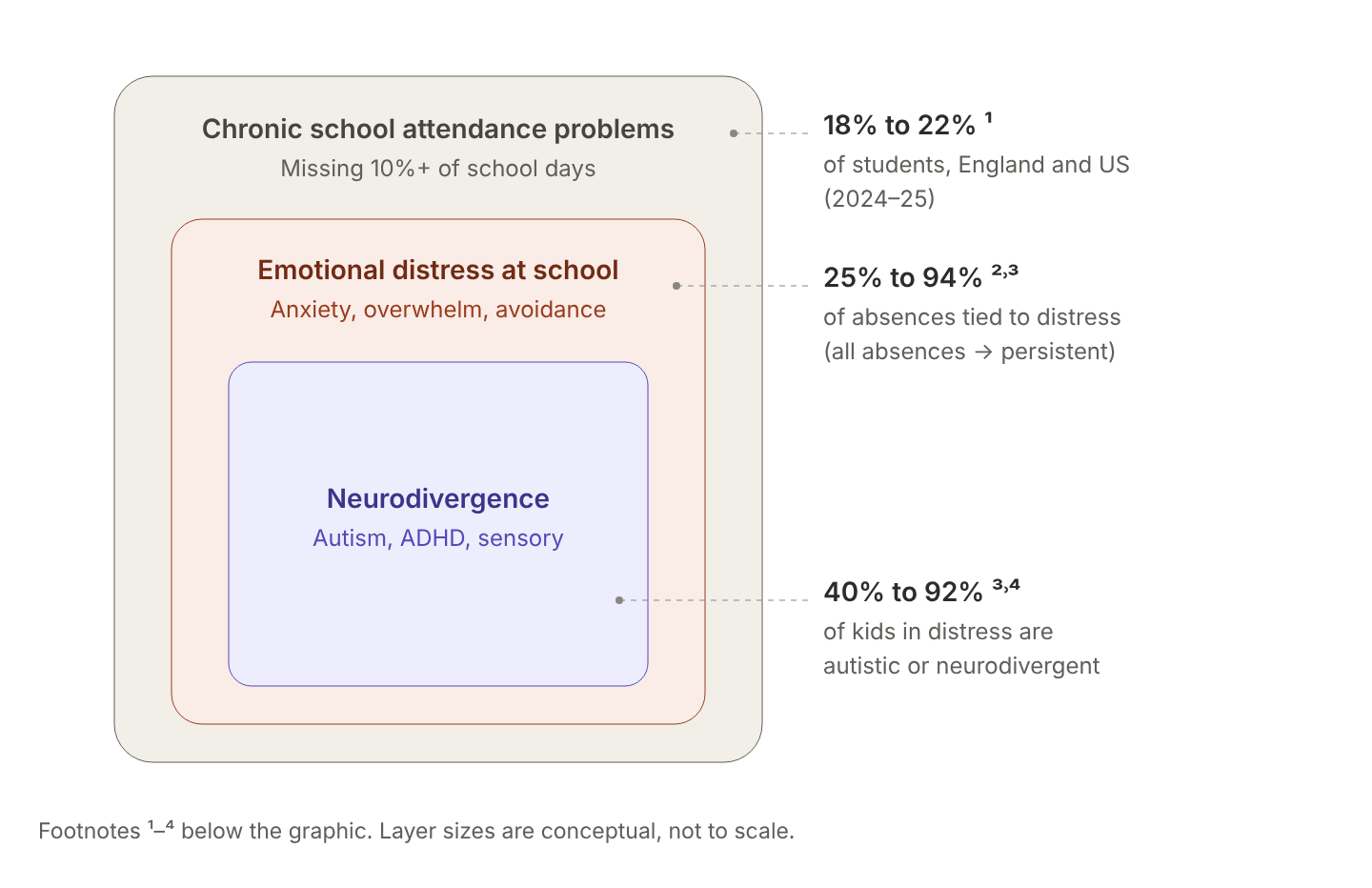
Of course, different schools have a variety of special education programs and supports. But what would it look like to take a step back and consider what these school distress signals might be telling us about the types of schools and school programs available to different profiles of students? I know from personal experience in neurodivergent-parenting communities that one of the more common (and usually desperate) social media posts in these groups looks like this:
My kid is X age and has X needs/personality/challenges. We are really struggling at school. The special ed staff are trying their best but it’s just not working. Does anyone have any recommendations for a school that would be a fit? We live in (area).
And more often than not, the responses to these specific posts are sparse. Not because people don’t want to be helpful, but because there is often so little to suggest. Anecdotally, that seems to especially be the case when the child is younger or has not succeeded in behaviorism-based programs.
What might it look like if there were a mechanism to identify and fill gaps and opportunities in types of schools/school programs? One example is Fusion Academy. It’s a private school chain built around one-on-one classes for grades 4-12. They grew from 43 to 85 campuses from 2017 to 2025. And tellingly, they’ve changed their positioning from talking broadly about flexibility and personalization to talking about supporting neurodiversity. I love this example of following the demand: recognizing that they were meeting an unmet need in behavioral health and neurodiversity, and repositioning clearly so that their customers can recognize it. (Hint hint for many healthcare companies).
Fusion is mostly a private-pay program, and is a specific model, so it’s not a solution for the whole market. But it is thought-provoking. So as municipalities take on chronic absenteeism, let’s think beyond getting kids back in the building. Let’s also ask which schools, programs, and re-entry pathways are missing, for what populations, and how to get more of the right ones built. If you’re thinking about this from the POV of therapeutic schools, district strategy, school-based BH services, or investing the space, I’d love to hear what you’re seeing.
Sources
¹ England: Dept. for Education, Pupil absence in schools in England, 2024/25 (18.14% persistently absent, administrative data). US: RAND (2025), Chronic Absenteeism Still a Struggle in 2024–2025 (~22%, district-reported estimate).
² Low end: PPIC, California Healthy Kids Survey 2023–24 (student self-report, all absences); UK Dept. for Education parent survey, June 2023, via Tes.
³ Connolly, Constable & Mullally (2023), School distress and the school attendance crisis, Frontiers in Psychiatry 14:1237052. UK volunteer sample of 947 families; neurodivergence includes suspected cases (confirmed autism: 47%).
⁴ Low end: earlier UK sample cited in Connolly et al. (40% autistic); Lissack & Boyle (2022), UK parent survey (51% suspected autism).