…and why that’s an opportunity for:
• Investors and founders looking for their next business
• Payors and employers concerned with trend
• Healthcare leaders identifying organic growth opportunity
Recently, I was speaking with a healthcare investor who had more or less written off the autism and neurodiversity market. He was concerned with reimbursement tightening in ABA, which is true.
But here’s the thing: ABA isn’t the same as autism, and autism isn’t the same as the broader topic of neurodiversity.
And the autism and neurodiversity space is still absolutely brimming with unmet needs that are real problems for families, payors, providers, and adults. These unmet needs are opportunities to serve people better and build businesses doing so.
“Autism therapy” isn’t actually a thing
Autism is an extremely broad and heterogeneous diagnosis. When someone has an autism diagnosis, they may have a wide variety of challenges. Those various challenges can be supported in different ways. Some of those ways are therapies. And one of those therapies is ABA.
In the US, ABA has been equated to “autism therapy,” and I regularly hear people use the two words as synonyms. I think this is misleading.
Let’s quickly review what ABA is: it’s an intensive program of behavior modification through structured reinforcement. At its simplest, a person will do more of a thing if the thing is followed by something they like. That often works, and it can indeed change behavior.
ABA is used to teach autistic children many different behaviors: how to complete hygiene tasks, how to ask for what they want, how to take turns when playing. Many families find ABA critical to improving their everyday lives, increasing safety, independence, or communication.
So: In the context of autism, ABA can help to improve lives and reduce suffering for some people in some situations with some problems. That’s important, but it’s not comprehensive.
Start with the problem, not the diagnosis
Saying someone has an autism diagnosis might mean you are talking about:
• A preschooler who is easy going but doesn’t speak
• A teen in mainstream high school struggling with anxiety and a limited diet
• An adult who learned to speak and read young but who struggles with emotional regulation
The diagnosis doesn’t tell you what problems the person or family is desperate to solve.
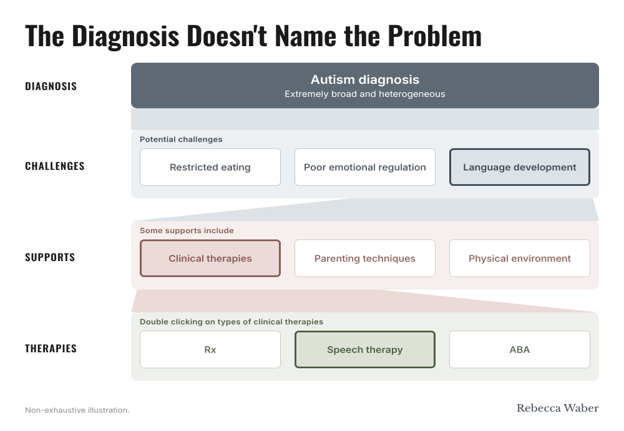
For any particular problem, there are likely different classes of solution that may be helpful:
• Clinical services. ABA might be one of them. Other clinical services might be too: a medical workup to find underlying causes of pain, prescriptions for sleep or attention.
• Non-clinical solutions. Quite likely, a variety of non-clinical solutions might be helpful, too: parenting skill-building, physical items, schools, activities.
There’s a whole world of supports out there, and more waiting to be developed, that match with different types of people, in different circumstances, with different needs.
Where are the market gaps?
From a consumer/patient/family perspective, and despite the large increase in spending on support services in recent years, many people are still struggling enormously. Some of the categories of these pain points include:
• Mental health and emotional wellbeing: High rates of depression, anxiety, suicidality, substance use, among autistic people. Also higher rates among family members.
• Education, childcare, adult care: Finding appropriate schools/placements can be impossible depending on profile, age and geography.
• Medical, dental: The population has higher rates of many medical concerns and higher difficulty accessing care.
Payors have increasingly significant pain points, too. Payors struggle to increase quality oversight across their network, navigate their members across their options, and efficiently run utilization management. Employers may want to support autistic and neurodivergent workers.
The increase in overall service cost, without necessarily increasing quality, is hitting payors, employers, and states hard right now.
Innovation is just emerging in these spaces. Examples include, for autistic adults, companies focused on mental health and social connection; for families, companies offering targeted childcare and insurance planning; for payors, services to evaluate quality across the network or ease the administrative work in utilization management.
Who benefits from a more comprehensive lens?
Today, we have a system that’s expensive for payors (insurance companies, states and employers), but still meaningfully lacking for the end users (adults and families). What’s more, the costs go beyond healthcare, affecting state budgets for education, foster care, and criminal justice; family finances and personal solvency.
Broadening our aperture from “treating autism” to “solving problems for the autistic population” is about choice, precision, and efficiency. ABA stays in the toolbelt, to be used when it’s the best tool for the job. When relationship-based parenting skills, a different school environment, or mental health therapies are the more effective route to solving the problem, we can take out that tool instead.
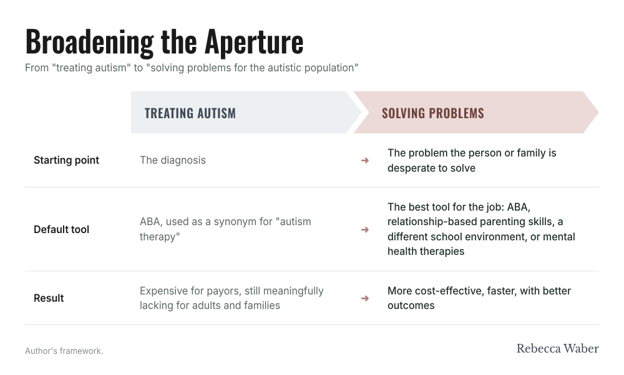
Using the right tool for the right problem is cost-effective, faster, and has better outcomes. Of course, it also opens up needs around evaluation, communication, and navigation that need solving too.
The autism market isn’t mature: it’s nascent.
It’s more complex than equating autism with ABA, but it’s also freeing: we can build against the significant pain points of autistic people, families, payors/states, and providers and bring clinical and business energy to them. That’s good for improving the lives of people who are struggling, and it’s good for creative business leaders looking for growth.